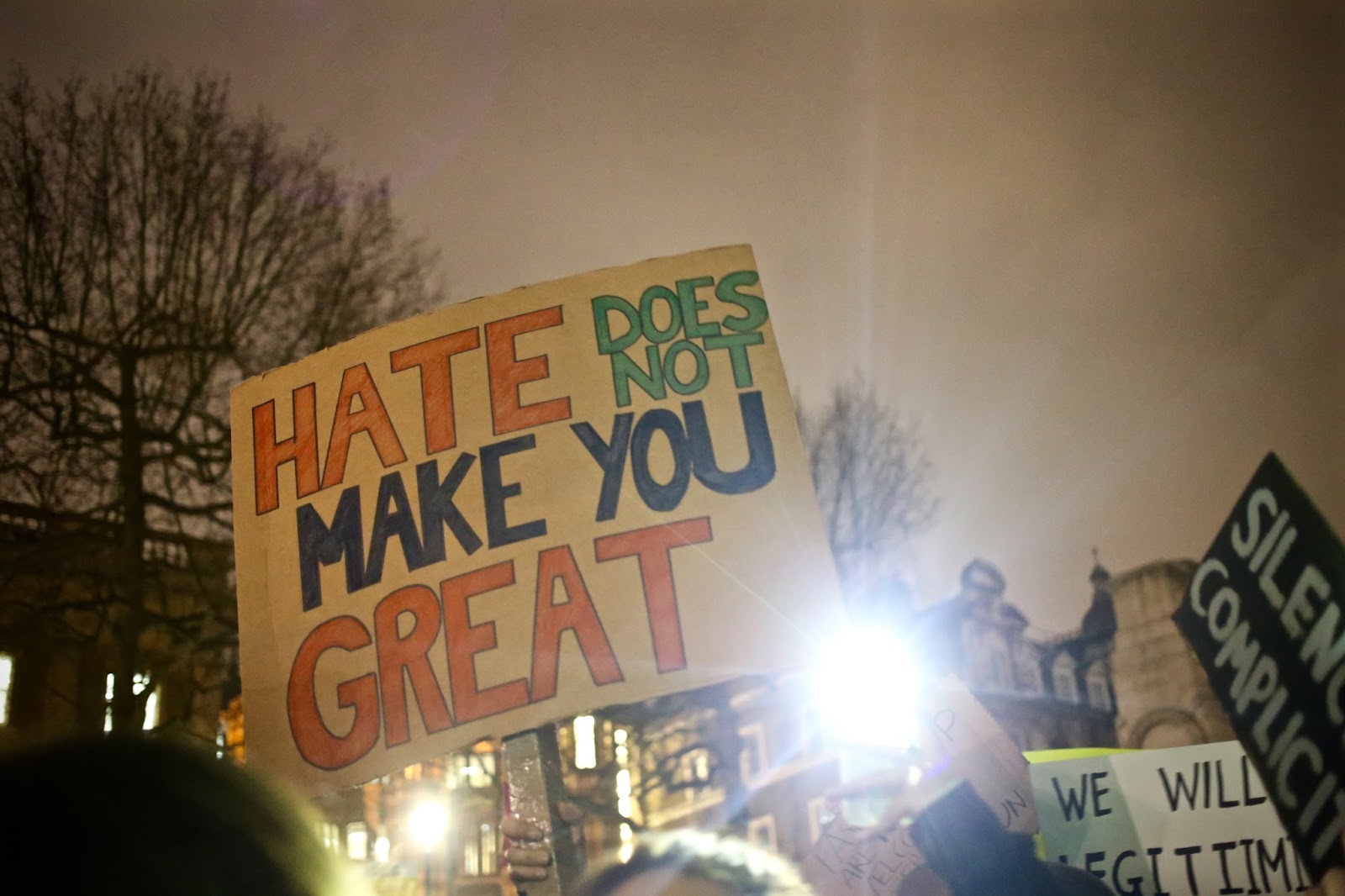
Owen Jones called for emergency demonstrations against Trump's #MuslimBan and the UK's complicity to be held across the UK today, Monday 30th January 2017. Here are my photographs from the London gathering outside Downing Street.
Taraji P. Henson as Katherine Goble in Hidden Figures (2016)
blackboard moment
noun.
A classic film scene in which the undervalued and/or bullied protagonist effortlessly solves a problem, especially mathematical, and displays their calculations on a blackboard. Often, everyone then recognises their brilliance. "Taraji P. Henson should have been nominated for that series of great blackboard moments."
Hidden Figures
Oscar-nominated Hidden Figures stars Taraji P. Henson as Katherine Goble, a mathematician at NASA who can do analytic geometry (whatever that means). This expertise allows her promotion from 'computer', reading data and carrying out mathematical tasks, to a member of the all-white, all-male top team engaged in cutting-edge research for human spaceflight. This biographical drama is basically chalkboard moment after chalkboard moment, which I think makes the film even more uplifting.
Good Will Hunting
The classic edition. Unrecognised genius Will Hunting (Matt Damon) is employed as a janitor at MIT. A professor played by papa Skarsgård challenges his students to solve a complex mathematical problem, and Will casually (and anonymously) puts the answer up on a board. In this clip, the professor puts up another, more difficult, problem. Using a blackboard in the corridor, Will solves that one too. Cue "oh my god" moment. How d'you like them apples?
x+y
Too shy to speak up in class, Nathan is a boy genius who struggles to fit in at a maths camp in Taiwan, where he is preparing to compete in the International Mathematical Olympiad. In this scene, he screws up his courage and talks through his solution to a maths problem. This is an unusually accessible explanation - a blackboard moment for normal people. (Well, sort of.) That could have made the scene less wowing, but its emotional impact more than makes up for the problem's simplicity.
Matilda
I was obsessed with Matilda as a child. Making chocolate fly into your hands and humiliating teachers? Hell yes. In this scene, Matilda uses her powers to pose as a ghost and accuse Miss Trunchbull of murder. Cool.
School of Rock
The blackboard moment that springs to mind in Jack Black's comedy about an unemployed, failing musician pretending to be a teacher is somewhat different. It doesn't quite fit the mould, but who's complaining? No one who's ever seen School of Rock will forget the scene in which he tries and fails to write Mr. Schneebly on the board.
You could also argue it has another, slightly more traditional blackboard moment. In the montage scene above, Dewey starts to become a real teacher, and uses the chalkboard to create a glorious mind map of musical genres and rock bands.
Pay It Forward (2000)
Find other examples of this trope in The Man Who Knew Infinity, Pay It Forward and Rushmore. A more basic version is simply equations-on-a-blackboard, which feature in countless films from A Beautiful Mind and 21 to A Serious Man and The Theory of Everything. Kevin Spacey, in particular, seems to have done loads.
A bit of Googling reveals that nerds get quite frustrated about gobbledygook on background blackboards and basic theories being used to show off a character's supposedly astounding intelligence. But in this post-truth, fake news world, I really don't mind. I always find this type of empty, 'look at this genius' stuff thoroughly enjoyable (probably also because I am clueless beyond GCSE-level maths).
Have I missed any good ones? What is your favourite blackboard moment in a film?
How many of you have ever felt personally victimised by Damien Chazelle? A follow-up to the brilliantly tense and passionate Whiplash, I went into the director's latest film, a romantic musical comedy-drama set in Los Angeles, thinking I was about to enjoy a classic love story. That's what the trailer led us to believe. (In fact, it cheekily highlighted moments from the film's final 'what could have been' sequence rather than its actual events.)
In the vein of '90s and '00s films such as My Best Friend's Wedding and The Break-Up, we were handed an anti-Hollywood love story. I should have guessed. The references to Casablanca were just one of the clues hinting that Mia (Emma Stone) and Sebastian (Ryan Gosling) were not going to make it. In some ways, it was traditional Hollywood, and I'm adult enough to acknowledge that.
But La La Land's dream-like quality and excessively cheerful opening scene seemed to suggest we'd be rewarded with a happy ending. The magic, the tap dancing, the stars: it all pointed to fate, serendipitous love. To spoil the best 'our song' a couple has ever shared, and mislead the audience by appearing to follow a predictable structure with a break-up in the middle, felt like emotional betrayal.
I understand the message of the film was that relationships doesn't always last forever, but can nevertheless profoundly change you in positive ways and that's honest and good. Oh yes, it's ever so mature and grown-up. But how could you (yes you, Damien) promise a fantasy, then punch me in the gut with a huge and hurtful heap of reality? That is just cruel.
8/10
(Surprised by my score? I loved most of the film. That's why I was so devastated. And I will never see it again.)
How would we communicate with aliens, if they ever made contact?Unless this question, along with physics, eternalism, linguistics, international relations and pacifism (or life, the universe and everything), sounds boring, you'll probably enjoy Arrival.
The new sci-fi film, directed by Denis Villeneuve (Enemy, Sicario, the upcoming Blade Runner reboot) and based on a short story by Ted Chiang, explores all the themes above and more. At the heart of it is theSapir–Whorf hypothesis, which contends that the language we use determines - or at least significantly influences - our world view. This idea is probed and dissected to an extent that seems just right, enough that it engages non-experts without alienating us.
Familiar philosophical disputes mingle with this distinguishing linguistic concept to great effect, and Amy Adams' understated (and excellent) performance allows the film's musings on non-linear time, telepathy and existential purpose to stand out. A chalky colour palette - the film is largely monochrome other than jolts of spacesuit orange - also helps.
The soundtrack is worth mentioning. Jóhann Jóhannsson, whose work includes the scores for Sicario, The Theory of Everything and Icelandic TV series Trapped, has created twenty suitably atmospheric, other-worldly songs, while Max Richter's poignant 'On the Nature of Daylight' opens and closes the film. Although the latter track has already featured in Stranger Than Fiction and Shutter Island, among other films, its use in Arrival seems particularly appropriate: Richter describes his album The Blue Notebooks as both an exploration of dreams and 'a meditation on violence'.
Arrival is the latest in a series of fantastically thoughtful and visually stunning sci-fi films, from Christopher Nolan's Inception and Interstellar to Gravity, Ex Machina and The Martian. (Brit Marling's more tangled, offbeat offerings, including Another Earth and new Netflix series The OA, also come to mind.)
There are irritants, of course. In classic Hollywood style, American patriotism leads to the Chinese being lazily portrayed as belligerent and game-obsessed, while the US overall appears to be an impotent, wide-eyed participant. (Their almost pacifist positions are all the more laughable considering recent events.) Co-star Jeremy Renner's character is unfortunately let off the hook despite ultimately shabby behaviour. But these are tolerable flaws.
Unlike the magnificently sprawling Interstellar, Arrival is a complete whole. Similar to its portrayal of time, the film is self-contained; each component links to another in a satisfyingly neat manner. While other ambitious features offer bags of unsolvable riddles, most of the queries put forward here are actually given answers. This somehow only increases its rewatchability - as soon as the foggy ending cleared and credits rolled, I wanted to dive into the spherical tale all over again.
MP Stephen Kinnock has declared that the Labour Party should stop engaging in 'identity politics' and start including the white working class.
“The huge mistake we’ve made, we have played the game of identity politics and identified groups, whether it is by ethnicity or sexuality or whatever you might want to call it, rather than say, ‘we stand up for everyone in this country and that includes you, the white working class’,”says Kinnock according to the Huffington Post. “Every group is actually struggling with the same problems of social mobility, the same problems of disempowerment, the same problems of feeling that they are being left behind. It doesn’t matter what the color of your skin is or what your background is.”
Apart from the fact he seems to have overlooked the glaringly obvious, which is that 'white working class' is an identity, Kinnock's statements are fundamentally wrong. Women are disproportionately affected by austerity: it hits us twice as hard. Cuts in funding for childcare, social housing and services for victims of domestic violence and sexual assault all attack women specifically. A UN report concluded that Tory policies have“systematically violated” the rights of disabled people. The gender pay gap presses on, as does the lesser-known ethnic gap. Although Kimberlé Crenshaw's concept of intersectionality has been watered down (largely by label-obsessed millennials who brand themselves 'intersectional feminists' without really knowing what that means), the Black theorist's study into interlocking oppressions is more relevant than ever as an analytical framework. We don't all struggle with the same problems. I will forever be unpacking the innumerable ways in which sex-based oppression has affected my life, but I will never experience the systemic disadvantages built into society that affect BAME people or disabled people. This is not to say we should ever fall into relying on the additive approach that Patricia Hill Collins warned against in Black Feminist Thought, which leads to Oppression Olympics. (Think 'How Privileged Are You?' Buzzfeed quizzes. Oppression isn't fun, don't make it cool in a race to the bottom.)
Instead, let's acknowledge that we are not all "left behind" to the same extent or in the same way, and that the Tory government uses different weapons for different groups. The NHS funding crisis, public sector job cuts and racist anti-immigrant rhetoric do not affect us all equally. Recognising 'identity', most usefully taken to mean the collection of immutable characteristics that determines our social groupings, does not stop us standing up for everyone in this country. In fact, it actually helps.
There's no better way of cooling yourself down in hot weather than grabbing an ice cream, but the usual supermarket fare can get dull. Why not mix things up by jumping on one of these exciting new trends? Once you've read The Social Media Guide to Food and our must-read pick of Instagram food trends, take a look at this batch of ice cream crazes and discover where you can get your hands on them. Post your indulgences on Instagram with our helpful photography tips and use the hashtag #hgicecream for a House & Garden double-tap.
Instagram's new 'stories' update has boldly incorporated the main ideas of Snapchat. Will Grammers and Snappers ignore Instagram stories, abandon Snapchat in favour of the update or give in and simply add it to an ever-expanding list of social media duties?
my first Instagram story
This update is particularly shrewd as Instagram has, until now, been a space reserved for slick images. The more professional your photo, the better. Over the years, Instagram users have created an app-specific aesthetic (bright and minimalist overhead shots) typified by the grain bowl-filled feeds of clean eating gurus Deliciously Ella and Madeleine Shaw. These best practice rules (which I outlined in a House & Garden piece) are difficult to follow consistently and do not suit the lazy.
Snapchat, where we feel permitted to post dodgy selfies, clumsy photos and shaky videos, has been filling that 'lazy' gap competently - just about. Its closed off framework requiring users to add friends rather than follow is a factor thats set it apart but also severely limits mass appeal. Anyone normal beyond their teenage years feels uncomfortable adding people as friendswithout knowing them in real life. (Perhaps we should be worried that following strangers is more acceptable than befriending them, but social media etiquette is another discussion entirely.)
Indeed, teenagers set up 'finstagrams' years ago. These private Instagram accounts where teens would post selfies and imperfect photos - deemed 'fake' as opposed to their primary 'real' accounts, which are public - may well be deleted now.
The stories of Insta-celebs, while very slightly shabbier, will almost certainly continue to give the impression that they lead perfect lives. But this update does give us all more freedom on Instagram. Being less picky about what to post is probably a good thing.
So, will the update succeed? Or be largely forgotten, like the direct messaging capability? Let's look at the pros and cons.
Instagram stories
PROS:
Two in one. You don't have to open another app. Pokemon Go players need all the battery they can save.
Glowing neon pen. Check out the third writing option. It looks cool. The marker style is nice too.
More text allowed.
Hide your story from specific people. A bit like customising the privacy settings of a post on Facebook, which is always useful when your entire extended family are friends with you.
More views. This is the big one. My first Instastory has already been viewed by 40 people, and I don't even have 40 friends on Snapchat. Great for loners/misanthropes/anyone who isn't a teenager.
CONS:
Can't choose the number of seconds, as far as I can see, unlike Snapchat.
Lack of clarity generally. It's fairly easy to add to your story by mistake.
Snapchat
Pros:
Incumbency. We're already using it, many have only just become accustomed.
Filters. This is the big one. Many of us open Snapchat simply to check out the latest filters, with 'beautifying' modifications and new voice changers being particularly popular.
Considering filter ideas can easily be stolen, it doesn't look good for Snapchat. However, extensive research conducted by me (a Twitter poll with 14 votes) shows that most intend to ignore the update.
You can't blame them. Bloggers and writers with social media profiles to maintain must already keep up with Twitter, Facebook, Periscope, Vine, Pinterest, Tumblr, YouTube, Instagram and Snapchat. Spending weeks or months getting used it, as Food Stories pointed out, means Snapchat may not be easily dumped.
“I was a chubby little Italian kid running around my family’s six restaurants.” That’s how Giorgio Fabian Honey describes his upbringing, and it’s this childhood that explains his passion for “good, honest, local food”.
Giorgio, who is based in Kentish Town, will soon open temporary restaurant Cucina Rustica in his local pub, The Rose & Crown. After taking on various roles in London restaurant businesses, from senior management to head chef, he decided to embark on a lone venture. Fortunately, pop-ups do not present the same challenges as permanent restaurants, which are notoriously prone to failure. Giorgio happily acknowledges that starting a pop-up avoids “all the hassle” and red tape. “This is the quickest way from getting an idea that’s in my head to another person’s mouth.”
The Italian chef is passionate about his neighbourhood, which reminds him of Italy’s provinces. “Fiercely local,” he summarises. “I feel people in Kentish Town want to get behind a local scene. People want to support local businesses.” This is where his attraction to hyperlocalism, the unique selling point of Cucina Rustica, develops.
“Italians have been doing the hyperlocal thing for decades, even centuries. My nan was telling me they don’t trade with money. They farm pigs and the next door neighbour farms tomatoes, so they trade a kilo of tomatoes for a couple of pork chops.” Giorgio believes in the ethos of “you scratch my back, I’ll scratch yours”, evoking the ‘shareconomy’ concept popularised during the recession.
North London produce is lovingly highlighted throughout the menu, which features sourdough bread from Muswell Hill fermented with the beer of a micro-brewer in N10, meat from a local butcher, pasta made in NW10, vegetable boxes from NW5 and Giorgio’s homegrown herbs and spices.
Traditional beef and pork meatballs in passata is his favourite item on the menu, though over half of it is suitable for vegetarians. One meat-free option is mozzarella and fresh fig bruschetta. I wonder whether the honey dressing is sourced locally, and after learning that it is not, I suggest asking the North London Beekeepers Association for leads. (Rumour has it that the honey made by Alexandra Road estate residents, which would be perfect, sells out instantly every year.)
Giorgio rejects the “gimmicky” food found on the pop-up scene, which is overflowing with meme-ified Instagram fodder. “People are trying to put comedic twists on things, naming burgers after famous actors. I thought it would be really great to concentrate on normal food.” Much like Padella, London’s hottest pasta bar, Cucina Rustica offers a respite from rainbow bagels, ramen burgers and Cronuts. Instead, simple Italian dishes are at the fore - and what’s not to like about that?
The Rose & Crown, 71-73 Torriano Ave, Kentish Town, NW5 2SG. From 2 August. www.rusticakitchen.co.uk
A week ago I received a text from an ex-flatmate from university whose final year coincided with my second. I helped out a little with his dissertation, for which he got a brilliant first! Around the communal kitchen table, we often discussed gender, compulsory femininity, and how class interacts with these forces.
I once painted his nails while we watched My Mad Fat Diary and he became very angry when I didn't have polish remover. He said I didn't understand how much shit he was going to get from his friends, that any expression of femininity was out of reach to him as a working class man.
After completing a masters at Cambridge, he is now looking at masculinity for a PhD thesis. When we spoke on the phone recently, he was happily on way to a date wearing mascara. He intends to enrol in an American university to start a new life as a more liberated man who cannot be identified as working class Mancunian and thus pigeon-holed.
This is his text (adapted very slightly to omit personal details):
"Hey, hope you're well. I was wondering if you could help me think through something. I just read a feminist critique of a book about masculinities in which the author's attitude was it was absolutely important not to claim men are oppressed by patriarchy. I'm pretty convinced, however, that is exactly the reason men kill themselves: death is better than admitting sadness. It matters because I want to be certain of my epistemological footing before I write my PhD proposal. The best I can come up with is that patriarchy is like capitalism, in that there are winners and losers but ultimately America, for example, is more powerful than "insert poorer country". I'm sure you know far more about this than me, can give me a heads up please?"
Today I got round to replying by email:
I agree with the feminist source you read re: men being oppressed by the patriarchy.
Men are not oppressed by the patriarchy. Do men experience disadvantages? Yes. Men feel emotionally restricted and put under pressure as breadwinners. But those disadvantages and limitations exist as drawbacks from a central purpose, which is to make men more powerful - opposing women's ‘hysteria’ and assuming financial control in the process.
Let’s use the body image discussion as illustrative of the wider debate. We say women are put under enormous pressure to be thin. Every woman I’ve ever met feels that pressure and our weight informs all interactions with each other and with men. Girls know from a very young age that being anything other than skinny means being of lesser value.
Men respond, ‘we also have to live up to expectations! When I look at a men’s magazine/comic/advert, I see a man with lots of muscles. That takes a lot of time, effort and resources, and can lead to men taking dodgy steroids, etc.'
1. Men are not *primarily* judged by their appearance to the extent that women are. The pressure is strong but a man who doesn’t have the physique of David Beckham isn’t seen as worthless.
2. Looking physically strong, having muscles, is a power fantasy. Men are encouraged to have muscles, which makes them bigger and stronger than women (and even more intimidating), whereas women are coerced into making ourselves smaller and weaker, to physically take up less space.
3. This power fantasy is a male fantasy. Men are encouraged to do look a certain way by other men. Who writes those comics and heads those advertising agencies? Men have built patriarchal structures; they didn’t just appear in a vacuum and they’re no mistake.
The discussion above can be extrapolated to answer your wider question of whether men are oppressed under patriarchy for being men.
A class based analysis is used for radical (not liberal) feminist theory. Men are the oppressor class. That doesn’t deny that individual men may be in worse positions than Theresa May. And you are not in a better position than Obama, despite your whiteness. Obviously, other axes of oppression are at play (cf Crenshaw on intersectionality, Patricia Hill Collins on the matrix of domination).
But are men being oppressed by... men? Here I’d look at Connell on hegemonic masculinity and conclude that the hierarchy of masculinities exists to keep standards of masculinity high. Competing forms of masculinity mean that gender non-conforming men are marginalised and subordinated, but ultimately the process serves to reinforce gender and the power of men.
This piece was originally published over at HOUSE by House & Garden. If you love food - whether that's eating, cooking or both - social media is indispensable. Instagram, Snapchat, Facebook, Twitter, Pinterest, YouTube, Tumblr... It's difficult to know where to start when there is such an overwhelming number of social media platforms and plenty of talented folk on every single one of them. Here's a list of our favourite social media movers and skakers in the food world. Whether it's useful cooking tips, stunning photography, creative recipe ideas or inspirational food styling you're looking for, bookmarking this guide will come in handy. If you think we've missed any out, please comment via Facebook below or let us know on Twitter@_houseandgarden. Dig in... House & Garden
Miss Foodwise is the pseudonym of Regula Ysewijn, a talented food stylist and self-confessed Anglophile from Flanders, the Dutch speaking part of Belgium. She is passionate about British food and its history, as evidenced by her beautiful cookbook, Pride and Pudding: The History of British Puddings, Savoury and Sweet (see our favourite recipes from it). Follow Regula on Instagram for pies, antique jelly moulds and sourdough loaves, all photographed in her signature moody style.
Smitten Kitchen Cookbook is one of the best. Full stop. We love Deb Perelman (read our interview with her). Her social media tagline is "the place to find your new favorite thing to cook", which is absolutely right; her recipes are inspired yet stunningly simple and totally doable. We're particularly excited about getting cooking tips and being taken on food tours by adding her on Snapchat.
Tacos at Tacombi, sweet potato fries at byCHLOE., green tea noodles at Mission Chinese Food, brunch pizza at Rubirosa, freakshakes at Black Tap, babka at Sadelle's. Hungry yet? If you plan to visit New York or take an interest in food trends (most of them start in the Big Apple, after all), follow Eating NYC on Instagram and add Alexa on Snapchat.
Authentic. That is the one word we'd use to describe London-based chef and food writer Olia Hercules. Born and raised in southern Ukraine, her award-winning 2015 cookbook Mamushka was a remarkable celebration of eatern European cooking. Olia's Instagram is made up of travel snaps, selfies and whatever else takes her fancy, and we love her feed for it.
Paola modestly describes her blog, Cravings in Amsterdam, as "easy recipes for everyday cooking". But it offers some of the most impeccable food styling we've ever seen - each dish is meticulously crafted to perfection. If you'd like to have a go at making an avocado rose, she has helpfully posted a tutorial video on Instagram. Add her on Snapchat to be taken on adventures in Amsterdam.